
1930's
The Beginning
The first meteorological instruments were introduced in George Town, Grand Cayman. A cooperative arrangement with the Cuban Government to broadcast meteorological information to ships via short wave radio from a shore transmitter to the ships receiving station (
Key Highlight
First meteorological instruments introduced
1950's
Hurricane Preparedness Era
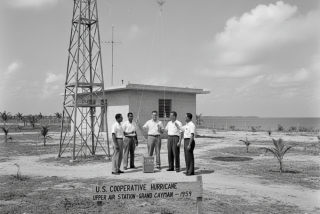
Following several hurricanes hitting the US East Coast, the US Weather Bureau set up 16 upper air stations across the Caribbean for early detection and warning. A Cooperative Hurricane Upper Air Station (CHUAS) was established in the Cayman Islands, operated jointly by Cayman and the US.
Key Highlight
Women pioneers in meteorology
This installation introduced Caymanian women into the STEM field of Meteorology. Three Caymanian women were recruited and trained to work at the station, as most men were away at sea.
1970's
Aviation & International Cooperation
Meteorology in the Cayman Islands changed significantly. Following an agreement at the Caribbean Meteorological Organisation (CMO), the Jamaican Meteorological Office began providing forecasts and severe-weather warnings for the Cayman Islands.
Key Highlight
Dawn of the jet age
With the increase in demand for international flights and the dawn of the jet age, aviation weather information services began to assist flights into and out of the Cayman Islands.
1986
Transfer of Operations
As air traffic into the Cayman Islands continued to expand rapidly, the Cayman Islands Government via the Civil Aviation Department requested a review of meteorological operations to satisfy the safety requirements of the International Civil Aviation Organisation (ICAO) and World Meteorological Organisation (WMO).
Key Highlight
Official handover from the US
The US officially handed over the Cooperative Hurricane Upper Air Station (CHUAS) to the Civil Aviation Department.
1990's
Independence in Forecasting
The Cayman Islands Civil Aviation Department was granted approval by the WMO to provide its own forecasts and severe weather warnings. This ended two decades of reliance on Jamaica for forecast and severe weather warning service.
Key Highlight
Cayman Islands Meteorological Office established
The start of the Cayman Islands Meteorological Office, headed by the Civil Aviation Department.
2010
A New Era Begins
Under the National Weather Service Law, the Cayman Islands was established as a stand-alone Government Department.
Key Highlight
Cayman Islands National Weather Service (CINWS) born
Recognized as an independent, fully-fledged national weather service.
Late 1970's
Growing Concerns
The Department of Civil Aviation became very concerned about the supply of weather information to pilots using the Grand Cayman airport. The problem was becoming particularly acute as the aviation traffic was increasing significantly.
Key Highlight
Aviation traffic increasing significantly
March 11-19, 1982
Meteorological Review
The Director of Civil Aviation carried out a comprehensive review of meteorological development of the Cayman Islands. As part of the plan, a two-day visit to Jamaica was conducted to meet with the Director of the Jamaican Meteorological Service.
Key Highlight
Strategic planning and regional coordination
The visit to Jamaica was necessary as they provided some weather information already and were now being asked to take over the responsibility for TAF's and severe weather warnings.
July 10, 1997
Gaining Responsibility
At the 19th Region 4 Hurricane Committee meeting, held in Nassau, Bahamas, the Cayman Islands Weather Service was given the responsibility for the issuing of Severe Warnings, TAF's, and other critical aviation weather products for the Cayman area.
Key Highlight
Full operational authority granted
This marked a significant milestone in the independence and capability of Cayman Islands meteorological services.
2003
Expansion to Cayman Brac
An observing branch was opened in Cayman Brac, extending meteorological services across the Cayman Islands and enhancing coverage for inter-island aviation operations.
Key Highlight
Multi-island meteorological network established
Improved weather monitoring and forecasting capabilities for all three Cayman Islands.